
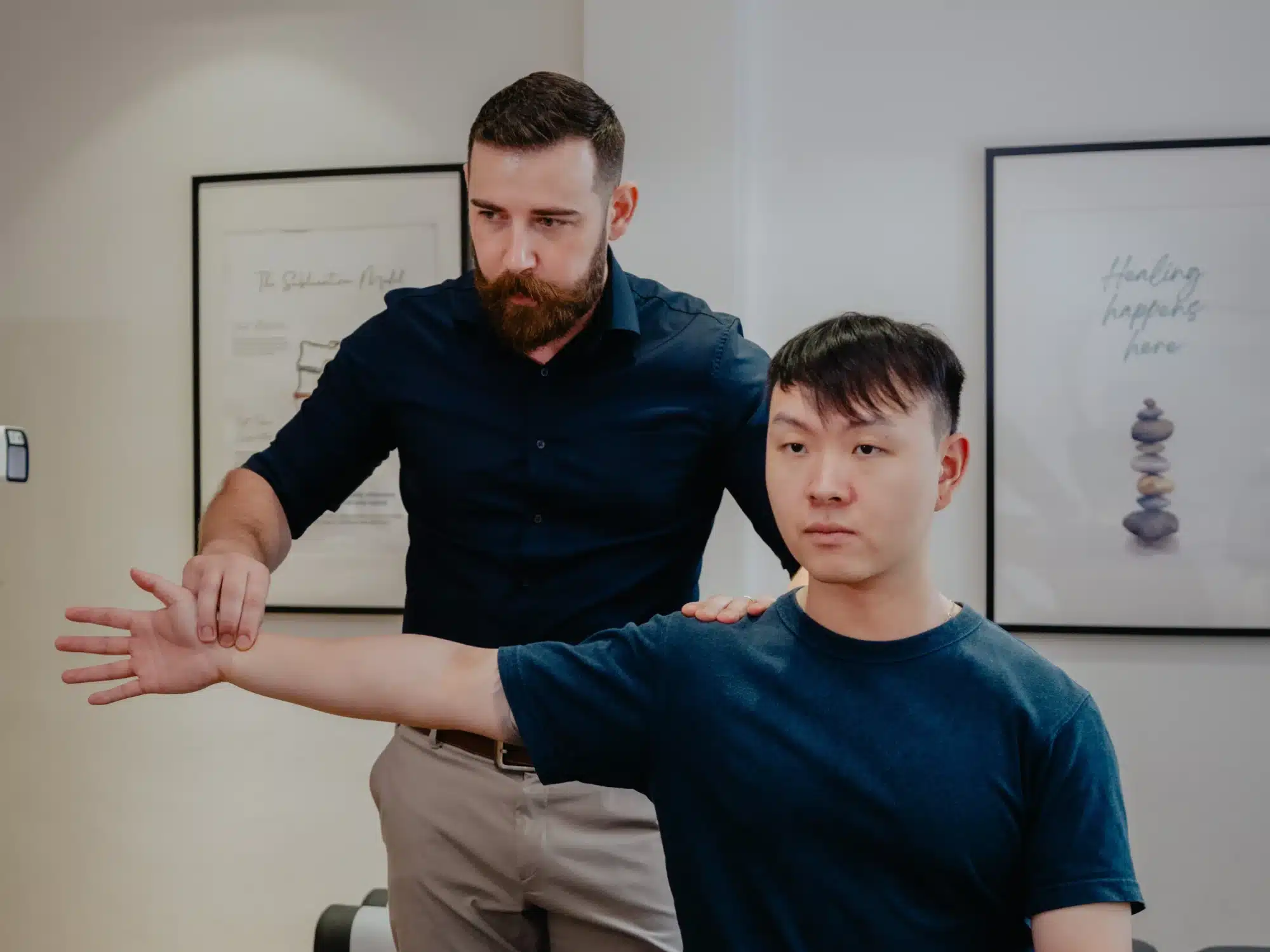
Repetitive tasks like office work and sports can cause painful elbow strains like tennis or golfer’s elbow. Chiropractic care in Singapore provides a non-invasive, conservative pathway that evaluates your entire upper body mechanics to address the root structural cause rather than just masking the discomfort.
Persistent joint strain is common in a fast-paced city like Singapore. Many individuals seeking an elbow pain chiropractor Singapore prefer exploring conservative, non-invasive paths before considering prescription medication or invasive surgery. Chiropractic care focuses on looking at the body as an interconnected system. By assessing joint alignment, muscle tension, and spinal health, a chiropractor helps restore normal mechanics to the arm, providing a path forward that addresses the root cause of the strain rather than just masking the discomfort.
Understanding Elbow Pain: Common Causes for Singaporeans
Discover how everyday office habits and recreational activities in Singapore place repetitive stress on your arm joints, leading to common strain injuries.
Lateral Epicondylitis (Tennis Elbow) Explained
Tennis elbow involves irritation of the tendons that connect your forearm muscles to the outside of your elbow joint. You do not need to play racket sports to experience this. Any activity requiring repetitive wrist extension, such as typing on a mechanical keyboard or lifting heavy grocery bags, creates micro-strain on these tendon attachments over time. The body attempts to repair these tiny tears, but continuous use without adequate rest can lead to localised, persistent soreness.
Medial Epicondylitis (Golfer’s Elbow) and Active Lifestyle Injuries
While tennis elbow affects the outer arm, golfer’s elbow impacts the inner side. This condition stems from repetitive wrist flexion and gripping. In Singapore, we frequently observe this in individuals who regularly play badminton, golf, or engage in heavy weightlifting at the gym. The constant strain from gripping a racket or barbell tightly can fatigue the forearm flexors, transferring excess load directly onto the inner bone.
Elbow Pain from Laptop Use in Singapore’s Corporate World
Working long hours in areas like the Central Business District often means poor workstation setups. When evaluating elbow pain from laptop use Singapore professionals frequently present with unique strain patterns. Working on a compact laptop forces the forearms into a prolonged downward rotation. Combined with using a trackpad instead of an ergonomic mouse, this layout places static stress on the muscles. The lack of proper forearm support means your tendons work overtime just to keep your hands level.
Recognising the Symptoms: Understanding Your Discomfort
Learn how to identify early warning signs of joint strain and understand when your symptoms might point to a deeper structural issue.
Early Signs of Elbow Tendonitis and Bursitis
Recognising early indicators can help you manage strain before it worsens. Structural tissue issues often present with specific, localised sensations:
- Morning Stiffness: A noticeable tightness in the joint when waking up, which gradually eases with movement.
- Localised Tenderness: Sharp discomfort when pressing directly on the bony bumps of the elbow.
- Mild Swelling: Subtle puffiness around the joint after a long day of repetitive manual work.
Tendonitis involves the irritation of these connective cords, while bursitis is the inflammation of the fluid-filled sac that cushions the tip of your bone.
Differentiating Joint Discomfort from Nerve-Related Sensations
It is helpful to distinguish between a localised joint issue and a nerve problem. A standard structural strain usually feels like a dull, aching soreness confined to the arm itself. Conversely, if you experience shooting sensations, tingling, or numbness traveling down into your ring and pinky fingers, a nerve may be compressed. Chiropractors conduct specific orthopaedic assessments to check whether there is a pinched nerve at the elbow or higher up in the neck.
The Kinetic Chain: When Elbow Pain Originates from the Shoulder
The body functions as an interconnected kinetic chain. Restrictive movement or poor mechanics in the shoulder girdle often forces the lower arm to overcompensate during daily tasks. If your shoulder lacks a full range of motion, your forearm muscles must work much harder to rotate your hand. Learn more about how we address upper body alignment in our guide to shoulder pain chiropractor care.
How Can an Elbow Pain Chiropractor in Singapore Help?
An elbow pain chiropractor in Singapore assists by evaluating the entire upper limb kinetic chain, including the neck, shoulder, and wrist, to identify the root cause of joint dysfunction. Through conservative management, chiropractors utilise non-invasive protocols to help reduce discomfort and restore function.
These methods typically include:
- Specific Joint Mobilisation: Gentle adjustments to restore alignment and normal movement patterns to the elbow joint.
- Soft Tissue Therapy: Addressing muscular imbalances and tension in the forearm flexors and extensors.
- Ergonomic and Rehabilitative Guidance: Providing targeted exercises and posture modifications to prevent strain recurrence.
The Chiropractic Approach to Elbow Care
An overview of the conservative, hands-on methods used to evaluate and support joint health during a typical consultation.
Extremity Adjustments and Joint Mobilisation
When you visit a practitioner, they do not just look at your spine. They carefully examine the radial-humeral and ulnar-humeral joints that form the elbow. If these small bones are not tracking smoothly, it can alter your entire arm movement. A chiropractor uses gentle, targeted mobilisation techniques to apply precise pressure to the joint, helping to ease restriction and restore a more natural range of motion.
| Treatment Approach | Primary Focus | Intended Benefit |
|---|---|---|
| Joint Mobilisation | Radial and ulnar joint alignment | Eases restriction, improves tracking |
| Soft Tissue Therapy | Forearm flexor and extensor muscles | Releases tension, reduces tendon pull |
| Rehabilitation | Progressive load exercises | Builds long-term muscle resilience |
Myofascial Management and Trigger Point Support
Persistent muscle tightness in the forearm exerts continuous tension on your tendons. Think of it like a tight rope constantly pulling on its anchor point. Chiropractors often utilise hands-on soft tissue techniques to target these hyperactive muscle knots. Relieving this secondary muscular stress helps take pressure off the sensitive tendon attachments, allowing the surrounding area to rest.
Complementary Modalities Utilised in Modern Practice
Depending on your specific situation, a clinic may use adjunct modalities alongside manual adjustments. Techniques like localised ultrasound or shockwave therapy are sometimes introduced. These tools deliver gentle acoustic waves or sound frequencies to the area, which appears to support localised blood circulation and assist the body’s natural tissue recovery process.
Recovery: Understanding Care Options for Elbow Pain
Explore how different conservative modalities can work together to support your journey back to comfortable, everyday movement.
A Multi-Disciplinary View of Tennis Elbow Treatment in Singapore
When exploring options for tennis elbow treatment in Singapore patients often wonder how different fields compare. Rather than viewing options as competing paths, a collaborative approach is often best. Chiropractic care focuses heavily on joint mechanics, spinal alignment, and nervous system function. This structural focus can complement the soft-tissue rehabilitation protocols commonly found in physiotherapy, offering a comprehensive way to look at upper body health.
Active Rehabilitation and Strengthening Exercises
Getting fixed adjustments is only part of the recovery process. True resilience requires active participation through movement. Progressive loading exercises are widely supported for helping to build up tendon strength. For instance, controlled eccentric exercises, where you slowly lower a light weight using your wrist, help the tendon adapt to tension safely.
Managing Expectations: The Reality of Tendon Recovery Timelines
Tendons have a relatively limited blood supply compared to fleshy muscles. Because of this physiological reality, recovering from chronic tendonitis requires patience and consistent load management. There are no instant fixes for structural strain. A structured plan focusing on gradual improvement is usually the most dependable way to ensure long-term joint health.
Safety, Costs, and What to Expect at Your First Consultation
Understand the practical details of a chiropractic visit, from market fee structures to safety guidelines and health benefits.
Financial Considerations for Chiropractic Care
Initial consultations across Singapore typically involve a full history taking and a physical assessment. Standard follow-up sessions generally vary depending on the clinic location and the complexity of care required, usually falling within normal market averages. Most reputable centres maintain clear, transparent fee schedules so you can review costs before beginning care.
Navigating Insurance Claims and Corporate Benefits
Many corporate health packages and personal accident insurance policies in Singapore provide coverage for chiropractic care. It is wise to review your policy details beforehand. Some insurance providers require a general practitioner’s referral to process claims, while others allow you to claim directly with the receipts and assessment reports provided by your chiropractor.
Contraindications: When is Chiropractic Modification Not Recommended?
Clinical responsibility means knowing when not to perform an adjustment. A qualified chiropractor will defer or modify care if certain health factors are present. These contraindications include acute bone fractures, active joint infections, severe joint instability, or advanced stages of rheumatoid arthritis. In these situations, a referral to a medical specialist is the standard protocol.
Ergonomic Tips and Lifestyle Modifications for Prevention
Simple, practical changes you can make today to protect your arm joints during work and daily life.
Ergonomic Adjustments for the Singapore Office Environment
Small tweaks to your workspace can help prevent repetitive arm strain from returning:
- The 90-Degree Rule: Keep your elbows bent at a right angle, with your forearms resting parallel to the floor.
- Ergonomic Mouse: Switch to a vertical mouse to keep your forearm bones in a more natural, uncrossed position.
- Laptop Stands: Use a separate stand and an external keyboard so your hands do not have to crowd together on a small surface.
Home Care Strategies for Temporary Relief
If you experience an acute flare-up after a busy day, simple conservative home management can assist. Applying an ice pack wrapped in a thin towel to the sore spot for fifteen minutes can help soothe localised discomfort. Gentle forearm stretches, performed by extending your arm straight out and lightly pulling your fingers back, can also help ease muscle tension during your scheduled work breaks.
Take the First Step Toward Functional Relief
Don’t let persistent elbow discomfort reduce your productivity at work or keep you off the court. At Chiropractic Singapore, our team focuses on identifying the biomechanical root causes of your musculoskeletal issues. Schedule your elbow and joint assessment today.



 Simple, no-pressure, and already trusted by Singaporeans.