

Published on: 14 October 2026
Taking a reliable carpal tunnel syndrome test is the critical first step to stopping hand numbness, wrist pain, and grip weakness before they disrupt your daily life. Patients often ignore early tingling, hoping it resolves on its own, only to experience sharp, radiating pain that makes holding a cup or typing impossible.
Understanding the clinical signs of median nerve compression empowers you to seek timely, non-invasive interventions. Rather than waiting for surgical necessity, early diagnostic testing can help pinpoint whether the nerve entrapment originates in the wrist, the arm, or even the cervical spine.
Key Takeaways:
- Recognise the early anatomical signs: Median nerve compression primarily causes numbness, tingling, and pain localised in the thumb, index, and middle fingers, often worsening at night.
- At-home tests provide a diagnostic baseline: Simple physical provocation movements like the Phalen’s maneuver and Tinel’s sign can help you identify mechanical nerve irritation prior to a clinical assessment.
- Professional diagnostics quantify the damage: Advanced clinical tools like Nerve Conduction Studies (EMG), ultrasounds, and MRIs are essential to measure the exact severity of the nerve conduction delay and rule out cysts or tumours.
- Symptoms can originate in the cervical spine: Wrist pain is frequently complicated by “double crush syndrome,” where nerve entrapment in the neck mimics or compounds carpal tunnel symptoms, making a differential diagnosis critical.
- Early conservative care prevents permanent injury: Addressing nerve compression promptly with nocturnal splinting and targeted chiropractic adjustments reduces the risk of irreversible thenar muscle atrophy and complex rehabilitation.
Identifying the Need for a Carpal Tunnel Syndrome Diagnostic Test
Recognising the early warning signs of median nerve compression determines when a professional carpal tunnel syndrome diagnostic test is clinically necessary. Delaying an assessment allows the inflammation to worsen, accelerating potential nerve degeneration. By evaluating your daily physical symptoms, you can decide if immediate clinical intervention is required.
What are 5 symptoms of carpal tunnel?
The five primary symptoms of carpal tunnel syndrome are localised numbness, tingling, burning pain, grip weakness, and radiating discomfort up the forearm. These sensations manifest due to compression or entrapment of the median nerve within the narrow passageway of the wrist.
- Numbness: A loss of sensation, particularly in the fingertips.
- Tingling: A “pins and needles” sensation often described as the hand falling asleep.
- Pain: A sharp or dull ache that can travel from the wrist up to the elbow.
- Weakness: A sudden inability to pinch or hold objects securely.
- Radiating discomfort: Aching that moves upward toward the shoulder during flare-ups.
Which finger hurts the most with a carpal tunnel?
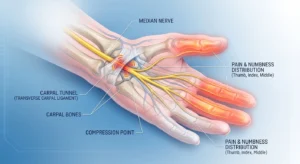
The thumb, index finger, and middle finger experience the most intense pain and numbness because they receive direct sensory input from the median nerve. The ring finger may also feel partially numb on the side closest to the middle finger. Conversely, the pinky finger remains entirely unaffected, as it is controlled by the ulnar nerve rather than the median nerve.
Why did I suddenly get a carpal tunnel?
Sudden onset carpal tunnel syndrome is usually triggered by acute wrist trauma, rapid fluid retention, or a sudden spike in repetitive manual tasks. Conditions that induce rapid swelling, such as pregnancy-induced edema or an acute sprain, compress the carpal tunnel space rapidly. Additionally, underlying inflammatory conditions like rheumatoid arthritis can flare up unexpectedly, placing immediate pressure on the surrounding nerve structures.
Performing At-Home Physical Examination Tests
Conducting baseline physical provocation tests at home helps identify mechanical nerve irritation before you step into a clinic. These simple orthopaedic movements are designed to temporarily increase pressure on the median nerve, reproducing your daily symptoms.
How to perform the Phalen’s Manoeuvre at home

The Phalen’s Manoeuvre is performed by pressing the backs of your hands together in front of your chest with your wrists fully flexed downward at a 90-degree angle. Hold this exact position firmly for 60 seconds without releasing the pressure. If you experience numbness, tingling, or pain in your thumb, index, or middle fingers within that minute, it suggests potential median nerve compression and warrants further clinical evaluation.
Understanding the Tinel’s Sign for nerve compression
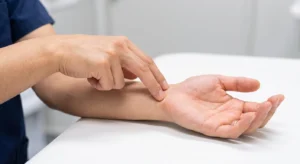
You can check for a positive Tinel’s Sign by lightly but firmly tapping the inside of your wrist, directly over the centre crease where the median nerve sits. Use the index and middle fingers of your opposite hand to tap the area consistently for several seconds. If this tapping triggers a sudden shock-like sensation or tingling shooting into your fingers, the nerve is highly irritable and inflamed.
What time of day is carpal tunnel the worst?
Carpal tunnel symptoms are notoriously worst in the middle of the night or immediately upon waking in the morning. This nocturnal aggravation occurs because most people unconsciously curl their wrists into a flexed fetal position while sleeping. This prolonged flexion dramatically increases carpal tunnel pressure, reducing optimal blood flow to the median nerve and often triggering tingling or aching that can disrupt sleep.
Discovering What Tests Confirm Carpal Tunnel Syndrome Professionally
A professional clinical diagnosis relies on advanced neurodiagnostic tests and medical imaging to accurately measure the extent of median nerve impairment. While physical exams provide a baseline, these specialised tools quantify the exact severity of the nerve conduction delay.
Exploring Nerve Conduction Studies and Electromyography
Medical doctors may order an Electromyography (EMG) to measure the tiny electrical discharges produced in your muscles to detect specific median nerve damage. This test involves inserting a fine needle electrode into specific muscles to evaluate electrical activity when muscles contract and rest. A complementary nerve conduction study uses surface electrodes to calculate how fast electrical signals travel down the nerve, instantly identifying where the signal slows down due to compression.
How diagnostic ultrasound and MRI locate nerve damage
High-resolution diagnostic ultrasound visually assesses the physical structural changes of the median nerve, identifying areas where the nerve is visibly swollen or flattened. Magnetic Resonance Imaging (MRI) can also be utilised to examine the anatomy of the wrist, ruling out tumours, ganglion cysts, or structural abnormalities pressing against the nerve. These imaging techniques provide a clear structural map of the carpal ligament and surrounding tissues.
What can be mistaken as carpal tunnel?
Cervical radiculopathy, wrist arthritis, and localised tendonitis frequently produce overlapping pain patterns that can be easily mistaken for carpal tunnel syndrome. Because nerve compression in the cervical spine often mimics wrist pain, consulting a Neck Pain Chiropractor can help determine if your symptoms are actually stemming from your neck. A precise differential diagnosis is mandatory to ensure you do not undergo wrist treatment for a spinal problem.
Understanding the Timeline: When Is It Too Late to Treat Carpal Tunnel?
Determining if it is too late to treat carpal tunnel syndrome non-invasively depends heavily on the duration of the compression and the visible deterioration of the hand muscles. Ignoring chronic nerve compression inevitably shifts the condition from reversible inflammation to permanent neurological deficit.
How long before carpal tunnel causes permanent damage?
If severe median nerve compression is left untreated over an extended period, it can eventually lead to permanent, irreversible nerve damage. As the myelin sheath surrounding the nerve deteriorates under constant pressure, the nerve loses its ability to transmit sensory and motor signals. Once this threshold is crossed, even surgical decompression may not fully restore normal hand function.
How long can a carpal tunnel go untreated?
Mild, intermittent carpal tunnel syndrome can go untreated for several years without causing catastrophic failure, but symptoms will progressively worsen over time. Patients often adapt to the initial tingling by shaking their hands out, slowly losing grip strength without realizing it. However, allowing the condition to persist significantly increases the likelihood of a longer and more complex rehabilitation process.
Spotting the signs of irreversible muscle atrophy
The most glaring sign of irreversible nerve damage is thenar atrophy, which presents as a visible shrinking or flattening of the fleshy muscle at the base of the thumb. When the median nerve is severely crushed for an extended period, it stops sending signals to the thumb muscles, causing them to physically waste away. If you notice a visible dent or severe weakness when trying to pinch your thumb and index finger together, the condition has reached a critical stage.
Seeking Non-Invasive Solutions: Chiropractic Care for Carpal Tunnel
Chiropractic care offers a highly effective, non-surgical approach to treating carpal tunnel syndrome by addressing both localised wrist restrictions and broader spinal nerve pathways. By restoring proper joint mechanics, chiropractors relieve the mechanical tension trapping the median nerve.
What is the fastest way to relieve carpal tunnel?
Combining nocturnal wrist splinting with targeted conservative care, such as chiropractic adjustments to the wrist and cervical spine, can be a highly effective approach for managing symptoms. When seeking fast, non-invasive relief, patients often explore the differences between TCM, Acupuncture, Tui Na, Cupping or Chiropractic to see which holistic modality addresses nerve compression best. Reducing physical pressure on the nerve helps restore proper blood flow, which gradually decreases local inflammation and numbness over time.
Addressing the root cause through neck and spine alignment
Because the median nerve originates from the cervical spine, addressing co-existing issues in the cervical spine can alleviate overlapping neural tension if ‘double crush syndrome’ is present, complementing localised wrist treatments. If a nerve is pinched at the neck, it becomes highly susceptible to even minor pressure at the wrist. Chiropractic adjustments ensure the entire neural pathway, from the spinal cord down to the fingertips, operates free of mechanical interference.
Consulting with a professional for a personalised plan
A thorough clinical examination is strictly necessary to formulate a personalised treatment plan that effectively targets your specific mechanism of nerve entrapment. Skip the surgical waitlists and book an appointment with Our Chiropractors today for a personalised, non-invasive assessment and recovery plan. Early structural correction helps relieve current wrist pain and can significantly reduce the risk of future degenerative nerve damage.