
Published on: 14 October 2026
If your shins ache after a run on Singapore’s hard pavements, shin splint stretches are probably the first thing you looked up. When you stretch, it matters as much as how. On a shin that is only mildly achy, gentle stretching can ease tight calf and shin muscles. On one that hurts sharply, it can make things worse.
Stretching is also only one part of getting back to running, because the shin itself needs rest and a gradual return to load.
Key Takeaways
- Stretching offers relief, but not a cure: While stretching eases tight calf and shin muscles to make movement more comfortable, clinical research shows it does not actively heal shin splints.
- Rest is the primary treatment: The most effective path to recovery is cutting back on your running mileage, letting the inflammation settle, and gradually returning to the track.
- Never push through pain: Stretches should always be gentle. Stop immediately if any movement increases your shin pain.
- Watch for red flags: If you experience pain in one highly specific spot, pain while resting, or numbness and tingling in your foot, seek a medical assessment before attempting to stretch or run again.
When Should You Stretch Shin Splints, and When Should You Rest?
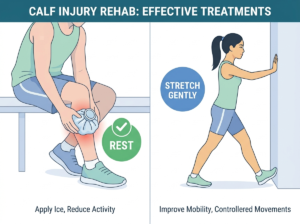
Stretch gently whenever stretching does not increase your pain, and rest from running whenever running or walking hurts. Use how the shin responds to decide.
| How your shin feels | What to do |
|---|---|
| A mild ache only after a run | Cut back your running. Gentle stretching is reasonable if it does not increase the ache. Ice the shin for up to 20 minutes, wrapped in a cloth, to ease pain. |
| Pain during a run | Stop the run and cut back your running load. Do not run through pain. Stretch gently only if it does not increase the pain. |
| Pain that forces you to stop, or pain when you walk | Stop running and let the pain settle. Return to running only once you can walk pain-free. Skip any stretch that hurts. |
| Pain at rest or at night, pain in one small spot, or numbness or tingling in the foot | See a doctor before you stretch or run again. |
4 Shin Splint Stretches, Step by Step
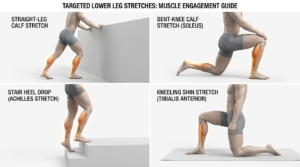
These four stretches cover the upper calf, the deeper calf muscle, the Achilles tendon, and the front of the shin. There is no proven stretching dose for shin splints, so the numbers here follow the American College of Sports Medicine’s general stretching guidance for healthy adults. Hold each stretch for up to 30 seconds, repeat it 2 to 3 times per leg, and stretch at least 2 to 3 days a week. Stop any stretch that makes the shin hurt more.
- Straight-leg calf stretch: Stand facing a wall with both hands on it at shoulder height. Step one foot back, keep that leg straight, and press the heel into the floor. Lean your hips toward the wall until you feel the stretch in the upper calf of the back leg.
- Bent-knee calf stretch: From the same position, bend the back knee slightly and keep the heel on the floor. The stretch moves lower, toward the ankle, into the soleus, the deeper calf muscle.
- Stair heel drop: Stand on the edge of a step and hold the railing, with your heels hanging off the back. Slowly lower your heels until you feel a comfortable stretch in the calf and Achilles tendon, hold, then rise back to level.
- Kneeling shin stretch: Kneel on a mat with your toes pointing straight back. Sit back gently toward your heels, staying upright, until you feel a mild pull down the front of your shins. Skip this one if kneeling hurts your knees.
Warming up first, easing in gradually, and never bouncing are the same rules that apply to chiropractic stretches in Singapore for the back and neck.
Should you stretch before or after a run?
After. Held stretches work best on warm muscles, so do them after a run or after 5 minutes of easy walking. Before a run, use moving warm-ups such as high knees, ankle circles, toe walks, and heel walks instead.
Which Stretching Mistakes Make Shin Splints Worse?
Four mistakes turn a helpful stretch into an aggravating one:
- Stretching into sharp pain: a stretch should feel like mild tension. If you grimace or hold your breath, ease off.
- Bouncing: bouncing in and out of a stretch can make the muscle tighten instead of lengthen.
- Stretching cold: held stretches work poorly on cold, stiff muscles. Walk for 5 minutes first.
- Pressing or rolling on the shinbone: direct pressure on the sore bone can aggravate it. Work the calf, not the bone.
Do Stretches Heal Shin Splints?
Research has not shown that they do. Stretching may ease tight calf and shin muscles, which can make walking and running feel better while the shin settles. StatPearls’ clinical review of medial tibial stress syndrome, the medical name for shin splints, builds treatment around rest, ice, and a gradual return to running, and lists stretching among the therapies with no proven benefit.
Shin splints are an overload injury of the shinbone and the tissue covering it, so reducing the load on the shin is the main part of recovery. That means two steps:
- Rest from impact: swap running for a low-impact activity such as swimming while the shin settles.
- A gradual return: rebuild your running volume gradually and increase training demands only when symptoms remain controlled.
Training overload is also a common cause of knee pain after running, so cutting back and building up gradually helps protect the knee as well as the shin.
Do strengthening exercises help shin splints?
They are a common part of getting back to running, but research has not established strengthening exercises as an effective standalone treatment for shin splints. Seated toe raises work the muscle at the front of the shin. Sit with your feet flat, lift your toes and forefeet while your heels stay down, pause, and lower slowly. A common starting point is 2 to 3 sets of 8 to 12 repetitions, which is general strength-training guidance, not a shin splint protocol.
How Chiropractic Care Supports Your Stretching Routine

Stretching deals with tight muscles. Chiropractic care looks at how you move and where the load on your shins comes from. A foot that rolls inward too far as it lands is a recognised risk factor for shin splints, and it is the kind of movement pattern a chiropractor checks for. Our chiropractors in Singapore assess how you walk and run, treat the joints and muscles involved, and help you plan your return to running. Book your appointment today at any of our five clinics, from Orchard to Jurong East.