
Published on: 27 November 2026
Carpal tunnel surgery is a common hand operation that releases pressure on the median nerve at the wrist. If a surgeon has mentioned it, you probably have questions about how it is done, how long recovery takes and what the risks are. This guide explains the procedure in plain terms so you can have an informed conversation with your surgeon. Only your doctor can advise whether surgery is right for you.
Key Takeaways
- It releases a tight band of tissue: The surgeon cuts the ligament that forms the roof of the carpal tunnel to give the nerve more room.
- There are two main methods: Open and endoscopic release give similar symptom relief over time.
- It is usually a day procedure: Most people go home the same day.
- Recovery happens in stages: Stitches usually come out after about 10 to 14 days, and grip strength can take a few months to return.
- All surgery carries some risk: Your surgeon will explain these before you decide.
What Is Carpal Tunnel Surgery?
Carpal tunnel surgery, also called carpal tunnel release, treats carpal tunnel syndrome, a condition where the median nerve is squeezed inside a narrow channel at the base of the palm. It is a specific nerve problem and is different from general wrist pain.
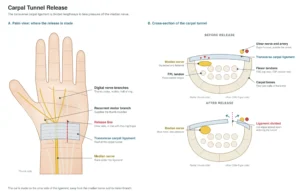
During the operation, the surgeon divides the transverse carpal ligament, the tough band that forms the roof of the tunnel. As the area heals, the gap fills with scar tissue, leaving more space for the nerve. The procedure is usually done under local anaesthetic, often as day surgery.
When Is Surgery Usually Considered?
Surgeons generally consider surgery when symptoms are severe, keep getting worse, or have not improved with non-surgical care such as splinting and activity changes. Constant numbness, weakness or wasting of the muscle at the base of the thumb, and nerve test results showing significant compression are other common reasons.
The decision depends on your symptoms, test results and daily needs, and it is made with your surgeon. If you have not yet tried other options, our guide to carpal tunnel syndrome treatment covers the non-surgical steps. The carpal tunnel syndrome test guide explains the nerve studies that help confirm the diagnosis.
Open Versus Endoscopic Release
There are two main ways to perform the operation. The choice depends on your surgeon’s experience and your circumstances.
| Feature | Open release | Endoscopic release |
|---|---|---|
| Incision | A short cut in the palm | One or two very small cuts, using a tiny camera |
| Symptom relief | Similar over time | Similar over time |
| Return to work | Standard | About 8 days earlier on average |
| Common minor issues | More wound and scar problems | More temporary tingling or numbness |
These comparisons come from a Cochrane review of 28 studies, which found the two methods similarly effective, with few major complications for either. The quality of the evidence was low to moderate, so your surgeon’s advice for your situation matters most.

Preparing for Surgery in Singapore
In Singapore, most people are referred by a GP or polyclinic doctor to a hand or orthopaedic surgeon, who may arrange a nerve conduction study before deciding on surgery. Ask the hospital or clinic which costs can be covered by Medisave or MediShield Life, as this depends on the procedure and your plan.
Questions to Ask Your Surgeon
- Which method do you recommend for me, and why?
- Will I have local or general anaesthetic?
- When can I drive, type and return to work?
- Will I need hand therapy afterwards?
- What symptoms should I report after surgery?
Recovery Timeline After Carpal Tunnel Surgery
Recovery is gradual, and timings vary from person to person. The figures below come from a Royal College of Surgeons of England recovery guide.
| Stage | Typical timing |
|---|---|
| Stitches removed | About 10 to 14 days |
| Light office or desk work | About 1 to 4 weeks |
| Moderate manual work | About 4 to 6 weeks |
| Heavy manual work | About 6 to 10 weeks |
| Full grip strength | About 6 to 12 weeks |
The scar can feel firm, lumpy and tender for a few weeks and usually settles by about three months. Pain at the base of the palm when gripping is also common during this period. If numbness was long-standing before surgery, it may recover slowly or only partly.
The First Two Weeks at Home
- Keep your hand raised on a pillow for the first few days to reduce swelling
- Move your fingers gently and often, unless your surgeon advises otherwise
- Keep the dressing clean and dry until your wound check
- Avoid heavy gripping, lifting and pushing up from a chair with that hand
- Take pain relief as advised by your doctor
Possible Risks and Complications
Carpal tunnel surgery is a well-established procedure, but like any operation it carries risks. These include:
- Wound infection or delayed healing
- Scar tenderness or pain at the base of the palm
- Temporary tingling or numbness
- Rarely, injury to a nerve or blood vessel
- Rarely, complex regional pain syndrome, a condition causing prolonged pain and stiffness
- Symptoms that do not fully settle or return later
Contact your surgeon promptly if you notice increasing redness, swelling, discharge, fever or pain that is getting worse rather than better.
Non-Invasive Chiropractic Singapore Treatments
Chiropractors do not treat the surgical wound, and rehab of the hand itself is usually guided by your surgeon or a hand therapist. Any chiropractic care after surgery should wait until your surgeon is happy with your healing.
Chiropractic care may still have a role in looking at the rest of the nerve pathway. The median nerve starts in the neck, and some people have irritation higher up, such as a pinched nerve in the neck, alongside carpal tunnel syndrome.
An assessment may include a spinal examination, posture analysis and checks of the neck, upper back and shoulder, with gentle care and workstation advice where suitable. If anything suggests a problem with your surgery, we will refer you back to your surgeon.
Frequently Asked Questions
Is Carpal Tunnel Surgery Painful?
The operation is usually done under local anaesthetic, so you should not feel pain during it, although you may feel pressure. Soreness afterwards is common and is usually managed with simple pain relief advised by your doctor.
Can Carpal Tunnel Syndrome Come Back After Surgery?
It is possible but not common. Symptoms can persist or return if the release was incomplete, if scar tissue forms around the nerve, or if there is another cause such as nerve irritation in the neck. Your surgeon can investigate if this happens.
How Long Will I Be Off Work?
It depends on your job. People in desk-based roles often return within a few weeks, while heavy manual work can take up to around 10 weeks. Your surgeon will advise based on your recovery.
When Can I Drive After Carpal Tunnel Surgery?
There is no fixed rule. You should be able to grip the wheel comfortably and make an emergency stop, and you should not drive while pain medicine makes you drowsy. It is also worth checking your car insurance policy, as some insurers set their own conditions after surgery.
Can Both Hands Be Done at the Same Time?
Some surgeons operate on both hands at once, while others prefer to do one at a time so you keep one hand free for daily tasks. Discuss the options with your surgeon.
Taking the Next Step After Carpal Tunnel Surgery
Recovering from carpal tunnel surgery takes time, and your surgeon or hand therapist will guide the care of your hand and wrist. Some people also have stiffness or nerve irritation in the neck and upper back, which is worth checking once your wound has healed.
If you would like your neck and upper back assessed as part of your recovery, book an appointment with our chiropractors once your surgeon has cleared you.