
Published on: 27 November 2026
A hip flexor tear usually happens in a single moment: a sprint, a kick or a sudden change of direction, followed by sharp pain at the front of the hip. Some tears are small and settle with time and structured rehab. Others involve the tendon pulling away completely and need a specialist opinion. This guide explains how to tell the difference, how a tear is confirmed and what recovery usually involves.
Key Takeaways
- A tear is a strain with torn fibres: Partial tears are more common than complete tears.
- A pop with sudden pain needs checking: Bruising, a limp or trouble lifting your knee are signs to get it assessed.
- Teenagers are different: In young athletes, the tendon can pull off a small piece of bone, called an avulsion fracture.
- Imaging confirms the severity: Ultrasound or MRI can show the size of a tear, and X-rays pick up avulsion fractures.
- Most partial tears are managed without surgery: Complete tears in athletes may be referred for a surgical opinion.
What Is a Hip Flexor Tear?
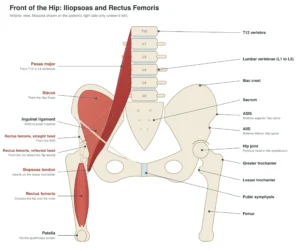
Your hip flexors are the muscles that lift your thigh towards your chest. The two main ones are the iliopsoas, which run from your lower spine and pelvis to the top of the thigh bone, and the rectus femoris, part of the quadriceps that crosses both the hip and the knee. A tear happens when some or all of the fibres in one of these muscles or their tendons give way.
Doctors often use the words strain and tear for the same injury. A mild strain stretches the fibres with only minor damage, while a tear means a clear break in the fibres, either partial or complete. Our guide to hip flexor muscle strain explains the three grades in detail, so this article focuses on the more serious end of that scale.
Common Symptoms and Underlying Causes
Most people remember the exact moment a tear happened.
Signs of a Torn Hip Flexor
- Sudden, sharp pain at the front of the hip or in the upper groin
- A popping or tearing feeling at the moment of injury
- Pain or weakness when lifting your knee, climbing stairs or getting into a car
- Bruising that may appear a day or two later and track down the thigh
- Limping, or being unable to walk normally
- A gap or lump in the muscle in more severe tears
How Tears Happen
Most hip flexor tears happen during fast, forceful movements, when the muscle is lengthening and contracting hard at the same time. A systematic review in the Orthopaedic Journal of Sports Medicine found that kicking was the most common cause of complete rectus femoris tears in athletes, followed by forced hip extension and sprinting. Football, rugby, martial arts and sprint training are common settings in Singapore.
If your pain came on gradually, sits deeper in the joint or is on the outer hip, a different problem is more likely. Our guide to causes of hip pain covers those possibilities.
Partial Tear, Complete Tear or Avulsion?
Severity shapes everything that follows, from how long you rest to whether you need a surgeon. Here is how the three main types usually differ.
| Type | What happens | Usual next step |
|---|---|---|
| Partial tear | Some fibres torn, muscle still connected | Assessment and a structured rehab plan |
| Complete tear | Muscle or tendon fully separated | Imaging and a specialist opinion |
| Avulsion fracture | Tendon pulls a small piece of bone off the pelvis or thigh bone | X-ray and a doctor’s review |
Avulsion fractures mostly affect teenagers, because the growth areas of their bones are weaker than their tendons. Common sites are the front of the pelvis, where the rectus femoris attaches, and the inner thigh bone, where the iliopsoas attaches. Many heal without surgery, but a doctor needs to check how far the fragment has moved.
How Is a Hip Flexor Tear Diagnosed?
A clinician will ask how the injury happened, then test your hip strength and range of movement and feel along the muscle for tenderness or a gap. Pain when lifting the thigh against resistance is a common finding. In Singapore, the usual first step is a GP or sports medicine doctor, who can refer you to an orthopaedic specialist if needed.
Imaging is used when a significant tear is suspected. Ultrasound and MRI can show where the tear is and how large it is, while an X-ray is the first test for a suspected avulsion fracture in a young athlete.
Seek medical care promptly if you cannot put weight on your leg, felt a loud pop with severe pain, have rapidly spreading bruising or swelling, or notice numbness in the thigh.
Treatment and Recovery
Most partial tears are managed without surgery. Care usually moves through stages: protecting the area, gentle movement, progressive strengthening and finally sport-specific training. Rushing back to sprinting or kicking too early is a common reason for re-injury.
Complete tears, especially in competitive athletes, may be referred for a surgical opinion. In the review mentioned above, athletes who had surgery for complete rectus femoris tears returned to sport after about 22 weeks on average, and the smaller group managed without surgery returned after about 12 weeks. The studies were small, so these figures are a rough guide rather than a prediction.
Recovery time depends on the size and location of the tear, your sport and how consistently you follow your rehab plan. Your clinician will set milestones, such as pain-free walking and full strength, before you return to running.
What to Do in the First Few Days
- Stop the activity that caused the pain rather than playing on
- Rest the leg and use crutches if you are limping badly
- Apply ice wrapped in a cloth for 10 to 15 minutes at a time to ease pain and swelling
- Avoid stretching or deep massage over the sore area
- Get it assessed if pain, bruising or weakness is significant
Non-Invasive Chiropractic Singapore Treatments
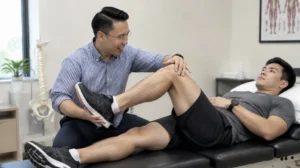
Chiropractic care can form part of the rehab phase once serious injuries have been ruled out. Your chiropractor will look at the hip alongside the pelvis and lower back, since stiffness or imbalance in these areas can change how load passes through the front of the hip.
What Your Assessment May Include
- Hip strength and range of movement testing
- A spinal examination and posture analysis
- Pelvic and lower back mobility checks
- A review of your sport, training load and how the injury happened
How Care May Help
Depending on your findings, care may include soft tissue work around, but not directly on, a recent tear, gentle mobilisation of the pelvis and lower back, and a graded strengthening plan. If your assessment suggests a complete tear or avulsion fracture, your chiropractor will refer you for imaging and a medical opinion first. Our guides to chiropractic for athletes and which clinic to visit for a sports injury explain how different providers fit together.
Frequently Asked Questions
Can a hip flexor tear heal on its own?
Small partial tears can heal with rest and a gradual return to activity, ideally with a structured plan. Complete tears and avulsion fractures should always be checked by a doctor, as some need surgery.
Should I stretch a torn hip flexor?
Not in the early stage. Stretching a fresh tear can pull the healing fibres apart. Gentle movement within a pain-free range is usually introduced first, with stretching added later once a clinician agrees it is safe.
How do I know if it is torn or just tight?
Tightness builds slowly and eases with movement, while a tear usually starts suddenly during activity and may come with a pop, bruising or weakness. If you are unsure, get it assessed before you train again.
How long does a hip flexor tear take to heal?
It depends on the size of the tear. Small partial tears may settle within a few weeks, while complete tears can take several months, as shown in the review above. Your clinician will base your return to sport on strength and pain milestones rather than a set date.
Do I need an MRI for a hip flexor tear?
Not always. Many partial tears are diagnosed from the history and examination. Imaging is more likely if a complete tear or avulsion fracture is suspected, or if you are not improving as expected.
Taking the Next Step After a Hip Flexor Injury
A sudden pain at the front of the hip is worth getting checked before you train again, because returning too early is a common reason tears come back. Knowing whether you have a partial tear, a complete tear or an avulsion injury shapes how long you rest and how you rebuild.
If a hip injury is keeping you out of training, book an assessment with our chiropractors. We will look at your hip, pelvis and lower back together and refer you for imaging if your injury needs it.